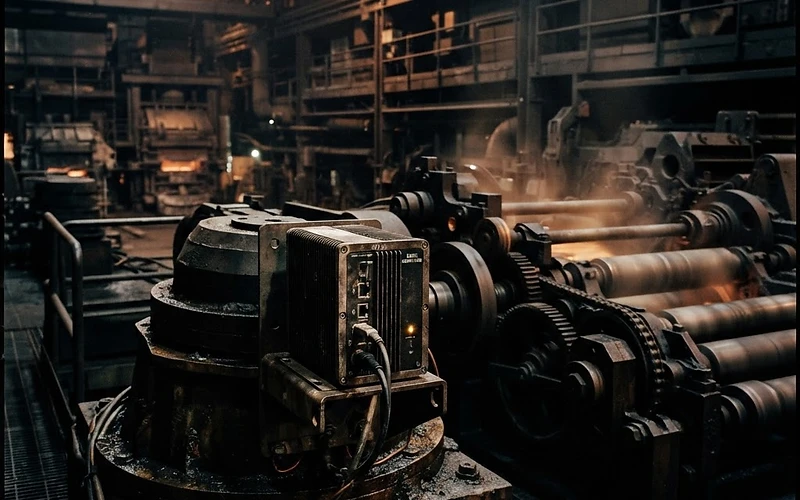
TelePods
A persistent industrial observer designed to build an evidence-backed understanding of one machine over time—connecting what it experiences, what people observe, what changes, and what happens afterward.
Many edge systems are built around the measurement. TelePod is being built around the machine.
A machine rarely announces a developing problem through one perfect signal. Vibration may shift a little. Temperature may drift. Sound may develop a harmonic. Motion may change by a fraction. Individually, none of those observations has to cross an alarm threshold. Together—and across time—they can become part of that machine's recognizable behavior.
SynapticSteel is designed around the opposite assumption: the machine becomes more understandable when physical evidence, operating context and attributable human observations are allowed to agree, disagree and evolve together over time.
Observation can be intelligent before anything moves.
Physical AI is often framed around robots and autonomous machines that perceive, reason and act. SynapticSteel starts one step earlier: build a persistent understanding of the physical situation before deciding whether any action is justified.
Perceive → Reason → Act
That model makes sense for robots, vehicles and autonomous machines whose job ends in motion or control.
Perceive → Retain → Compare → Contextualize → Govern
Many industrial assets should be observed continuously without being handed autonomous control. The value is the retained evidence, the changing relationships, the human context around the machine, and the explanation that helps authorized people decide what happens next.
General-purpose Physical AI does not have to mean one machine that can do every task.
SynapticSteel is pursuing a different kind of generality: carry the same observation, memory and reasoning architecture across many kinds of assets, then adapt what it watches and remembers to the assignment.
One intelligent machine performs many physical tasks.
That is a powerful direction for robotics: build a body and intelligence stack capable of manipulating, navigating or acting across many situations.
One observer architecture can learn many different physical assignments.
A motor, process line, electrical cabinet or compute room does not need the same body. It needs a reusable way to sense, retain context, recognize change and reason about what that environment is doing.
The unit is not the story. The evolving understanding of the machine is.
Multiple physical perspectives can enter one local intelligence path without turning the public story into a parts list. The interface below is a conceptual view of that relationship—not a disclosure of the implementation.
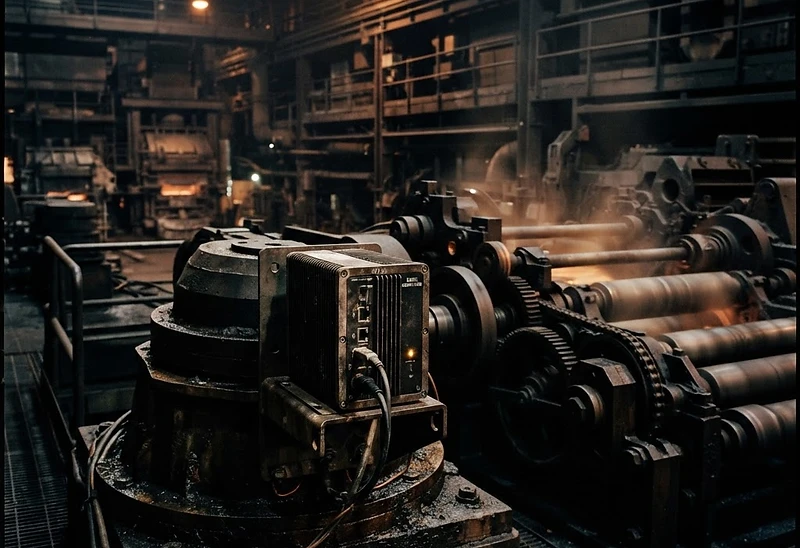
A persistent presence beside the asset — designed to become more than a sensor that simply reports.
The TelePod is designed to stay close to the machine, retain what it has observed, and build the context needed to distinguish noise, normal variation, and developing change as the system is validated in real operating environments.
Discuss a deploymentMany senses. One observer.
The differentiation is not the sensor count. It is what happens after the signals arrive.
Multimodal perception
TelePod is being built to combine vibration, sound, vision, thermal, depth, field, environmental, machine and network evidence instead of treating each sensor as a separate appliance.
Temporal context
A spike, a repeating pattern and a slow drift can share the same instantaneous reading. TelePod is designed to preserve enough state to tell the difference.
Edge reasoning with memory
The goal is not only to interpret evidence close to where it is produced, but to retain enough local behavioral context that each new observation can be judged against what this particular asset has already experienced.
Governed action
Observation, model belief and operator intuition can all inform the evidence state without automatically becoming authority. High-impact changes remain behind explicit human boundaries.
Evidence before language
A reasoning model should not be asked to hallucinate meaning from a torrent of raw sensor values. SynapticSteel is designed to build structured physical evidence first.
One architecture. Different physical environments.
The target is not a one-purpose bearing monitor or a camera that only knows one inspection task. TelePod is being developed as a reusable edge platform whose context, baselines, sensor weighting and specialist models can be adapted to the asset it is assigned to observe.
Don’t just detect a change. Build enough context to understand it.
SynapticSteel is actively developing this architecture. If you have an industrial environment where existing monitoring leaves important context on the floor, that is the conversation we want.
Start the conversation